Thursday, September 24, 2015

Notes from No Man's Land

"This impossible equation equaled out, of course, only if one was willing to assume that some human lives are more valuable than others. This, in the name of "morality."
Eula Biss
Notes from No Man's Land

A couple of weeks ago I read On Immunity, by Eula Biss, and was so impressed by it that I went out and found her collection of essays on race in America immediately after.

A couple of weeks ago I was discussing the Refugee crisis with my little sister and she said that it was so bad because "people believe that their lives are more valuable than others" and it amazed me how, while the occasions and situations are different, the underlying issues that we are talking about seem to be the same. (If you don't know about the refugee crisis, read some news, watch this video, educate yourself because this is important.)

Notes from No Man's Land is brilliant. In it are a collection of essays about different experiences the author has had in different locations in America. It is brilliant. It is split into three parts, New York, California, and the Midwest, and each offers different stories about race in America and offers brilliant insights on gentrification, various expressions of racism, and how they are linked to place. Eula Biss's prose is beautiful, her essays are well thought out and well researched, and I think that this essay collection is extremely important.

The issue of race is an extremely tender issue in America.  It is still prevalent in social policies, yet there is still a pervasive denial of it as no one wants to admit how they benefit from it (John Metta's essay discusses this wonderfully). Biss explores the subject from several different angles, class, ignorance, blatant racism, fear. In one essay, she deconstructs Little House on the Prairie, showing how the "otherness"  leads to fear, and how this fear, and the spreading of it, is a harmful action, "Inspiring fear in others is often seen as neighborly and kindly, instead of being regarded as what my cousin recognized it for-a violence." 

The essay that touched me the most was the one about guilt. I feel very guilty for how my country, and my ancestors have treated the "other:" Native Americans, African Americans, Muslims, Latinos, any one labeled as "other." I've struggled with the question of how do we move forward when people still feel such irrational fear, and why people still feel such fear. "We are afraid, my husband suggests, because we have guilty consciences. We secretly suspect that we might have more than we deserve. We know that white folks have reaped some ill-gotten gains in this country. And so privately, quietly, as a result of our own complicated guilt, we believe that we deserve to be hated, to be hurt, and to be killed." To deal with this guilt, it seems that most Americans have chosen to deny it. To claim that these feelings are justified because of racist reasons and ignore the deeper problems and the lasting inequalities.

This collection was phenomenal. I highly recommend it, to everyone. The prose is beautiful, the essays filled with sociopolitical insights, and the subject matter extremely relevant.

Monday, September 21, 2015

Euphoria

"I thought we had time. Despite everything, I believed somehow there was time. Loves first mistake. Perhaps loves only mistake."
Lily King
Euphoria


I loved this book. Euphoria, by Lily King, follows the story of three anthropologists in New Guinea in the 1930's, and the story is charming, heartfelt, and wonderful. I fell in love with one of the characters, while thoroughly hating another. It was wonderful.

The book follows the story of Nell, Fen, and Bankson: three anthropologists studying the tribes in New Guinea. Nell and Fen are married and share the work, but there are tensions in their marriage that stem from the inability to bear a child, their different styles of research, and Nell's success that Fen feels he lives in the shadow of. They meet Bankson after hastily fleeing the tribe they were studying, and the lonely Englishman gets to know them and gets drawn into their lives as they study new cultures.

I loved this book. I didn't think I would at first because I don't generally like books with love triangles, but this one was pulled off so well. I loved that it touched on several big issues. Death is talked about a lot, and King seems to contrast the ritual homicides that the tribes of New Guinea practice with the mass deaths of World War I. In one scene Bankson describes the war to a native man who can't wrap his head around the number or the reason for all the death, and Bankson struggles with the meaninglessness and brutality of the number. It also examines the idea of suicide, containing the most well done suicide scene that I have ever read. 

Nell was a fascinating character. Based loosely on the life of Margaret Mead, she examined some of the most fascinating ideas in the book. Kind, hardworking, and passionate about people, she examines the issues of people belonging to other people and the control we exert on them. This ideas she teases out while working with Bankson, while living with Fin and his efforts to control her life. She states "my loves remain wine to me, yet I become too quickly bread to them." She is referring to how new relationships are exciting and new, but how they eventually become a staple like bread. I fell in love with Nell, she was so fascinating and brilliant and kind.

The twist at the end of the book took me completely by surprise. It was the perfect ending to the story. I loved it. I highly recommend this book, to everyone.


Wednesday, September 9, 2015

Never Cry Wolf

"I had made my decision that, from that hour onward, I would go open-minded into the lupine world and learn to see and know the wolves, not for what they were supposed to be, but for what they actually are."
Farley Mowat
Never Cry Wolf

Originally published in 1963, Farley Mowat book Never Cry Wolf changed the way we think about large predators in North America. The wolf has been stigmatized for its role as apex predator, and for a long time was actively hunted in the lower 48 states to near the point of extinction, and for the longest time it was believed that wolves hunting patterns were driving the deer and caribou herds to extinction. Mowat's research showing that apex predators were necessary to keep the herd healthy, and that wolves weren't mindless killers, was crucial to their conservation.

This is a conversation that I feel is important to have again and again, considering all of the stereotypes that surround the wolves, the wolf hunts still being conducted in Alaska and Canada, and the poaching that occurs in the lower 48 states. It is important to educate people, especially when there are movements to reintroduce the wolf to Colorado (read more here).

This is a truly amazing piece of nature writing, chronicling Mowats time in the tundra researching the wolves, and his particular interactions with a small family group. It's well written, its informative, and its hilarious. The amount of humor packed into it blew me away, I especially loved the story about when Mowat ran across the tundra naked to witness a hunt, only to find that his friends mother had run out with the teenagers of the family to save him, thinking that he had gone mad. The prose was beautiful and elegant, and the relationship that the author establishes with the wolves is so wonderful. 

I think the best thing about this book was the subtle but underlying theme that humans embody all of the horrible things that have been said about the wolves, and that we are missing out on something by disrupting the natural stream of things. Our fear of nature and the unknown is so debilitating that it has caused us to loose where we fit in in the grand scheme of things. This feeling is driven home by his concluding sentence, which is just to beautiful not to share:

"for me it was a voice which spoke of the lost world which once was ours before we chose the alien role; a world which I had glimpsed and almost entered...only to be excluded, at the end, by my own self."

This book was fantastic. I think its a very important read, and a beautiful one at that. And if you don't want to read the book there is also a wonderful movie based on it, which I highly recommend.


Tuesday, September 8, 2015

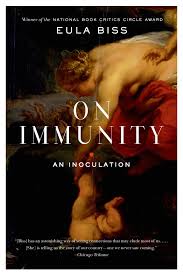
On Immunity: An Inoculation

"It spelled 'munity,' from the Latin munis for service or duty."
Eula Biss
On Immunity

Over the past few days I have been sick. Yesterday was horrendous; fever, vomiting, shakes that were so bad I thought my teeth were going to rattle out of my mouth. Today has been better; aches, pains, drowsiness, dizziness. I figured I might try to read a little about Inoculation and the discussions concerning it with the 'anti-vaxer' movement. 

On Immunity, by Eula Biss, is a well researched book that is part micro-history of vaccines, part commentary and critique of how we talk about disease and vaccination, and part memoir as she explains the choices she made and how she felt about vaccination before and after her son was born. This book was magnificent. It wasn't judgmental, as so many discussions about this argument are (I can be very judgmental about this topic), but instead explained the information available and how it could lead to the conclusions that both sides come to. She explains how one parents decisions to vaccinate their child can come from the same place as another parents decisions not to. We are all afraid, and the issue is complicated.

My favorite parts of the book were when Biss examined the metaphors we use to describe diseases and vaccines. She went back to Dracula and examined the myths of filth that surrounded sickness throughout various times in history, examining how class effects how we view sickness, and how being sick is often thought of as a crime of "otherness" and how this effects the way people make the decisions on what vaccines their children will receive. It was fascinating, to see how the language used effects the way people think about the issue, and how the metaphors used on this particular issue can effect the way one thinks about another issue. 

Another thing I thought this book did really well was explain the history of vaccines and the plethora of information that exists about them. It was fascinating to learn about. I had a fairly good idea of how vaccines work and are manufactured, but the history of them is really cool. China began vaccinating people against small pox in the 17th century, well before they began vaccinating in Europe. The earliest vaccines seem incredibly odd and unsafe but even back then they were considered a necessary risk.

This book was amazing. I definitely think that it a must read for everyone, especially if you have the opportunity to make the decision whether or not to inoculate your child. I personally think that vaccination is a no-brainer, the rewards, in my mind, greatly justify the risks. I think anyone who has been exposed to the information and life experiences I have will come to the same conclusion. But the issue is complicated, and it is understandable for there to be differing conclusions. After all, the rejection of inoculation is not a new thing, though the reasons change from region to region and time to time, as the idea of whether or not to vaccinate is often tied up with different issues, like class and race, and ideals like freedom and autonomy. This was a wonderful read and I highly recommend it.

Saturday, September 5, 2015

George

I love kids books. I love how they deal with issues a lot of kids face: bullying, family problems, all the problems of growing up. This was the first time I have seen a kids book tackle this issue, and it did it in such a charming and wonderful way.

George, by Alex Gino, is about a fourth grade girl who was born a boy, and her struggle to fit into her own skin when she can't self express. When her class puts on a play of Charlotte's Web, George wants to play Charlotte but is told she cant because she's a boy. Her friend Kelly (who is such an amazing character) conspires to switch places with her during the school play so that everyone can see George for who she really is: a girl.

This book was wonderfully charming. It dealt with the issues that transgender children face when they are learning to self express themselves. I love how Kelly never questioned the fact that George is a girl, once she found out, and neither did Scott, Georges older brother. It dealt with Georges mother wrapping her head around the Georges identity and being worried because "life is already hard."

This book was wonderful. I'm sure that it will be challenged in schools, but I feel that books that deal with anything of substance generally are. I hope a lot of people read it. It is such a charming story with a very wonderful message that I feel more children need to hear, regardless of their gender, age, or sexual orientation: "Be who you are."

Friday, September 4, 2015

Slaughterhouse-Five

"It is so short and jumbled and jangled, Sam, because there is nothing intelligent to say about a massacre. Everybody is supposed to be dead, to never say anything or want anything ever again. Everything is supposed to be very quiet after a massacre, and it always is, except for the birds."
Kurt Vonnegut
Slaughterhouse-five

I have been told, multiple times by multiple people, that the firebombing of Dresden was the cross that Vonnegut carried his entire life. Those exact words: "the cross he carried." I wonder what it is about that particular phrasing that latches those words to this story. No matter, they are fitting. 

This is the Vonnegut book that it seems most people have read. Its common high school reading. "So it goes" is often referenced. I am happy that it wasn't the first book by him that I've read. I feel that I wouldn't have understood the context as well, the complex emotions he felt, and the guilt he experienced if I hadn't read some of his other books first. Kilgore Trout, from so many Vonnegut novels, is present to explain why science fiction is important and how people make up their own fictions every day to live with what has happened. Mr. Rosewater, of God Bless You, Mr. Rosewater,  shares a room in the veterans hospital with Billy Pilgrim (our protagonist) after he accidentally shot a fireman during a flash back. Howard W. Campbell, Jr., from Mother Night, appears to convince the prisoners of war to join his all American platoon to fight for the Germans against the Russians and then waits out the firebombing in a meat locker with the prisoners of war while the rest of the city burns. The intricacies and the absurdities pulled in from the other novels provided a wonderful backing to the story, and an intricate back story that made the absurdities Vonnegut points out more profound.

In Slaughterhouse-five we follow the story of Billy Pilgrim, a time challenged man who jumps from occasion to occasion in his life. He doesn't understand this until he is abducted by aliens who see the fourth-dimension, While he can't see his life as they do, he knows what will happen, how he dies, how he is born, and everything in between and nothing will change because that is how the moment is structured. The story is his life, bouncing around but centered around the firebombing of Dresden, an event which killed more people than the atomic bomb at Hiroshima. There's a certain helplessness as Billy struggles to find the reason behind the things that he has seen, the things that have happened and will happen. 

This is a struggle that I think Vonnegut grapples with in most of the books I have read by him. The question of how do we make sense of the terrible things that have happened, and, since we are "so much the listless playthings of enormous forces," how and why should we go on? These are questions I feel like many people struggle with.

In Slaughterhouse-five there is a novel, written by Kilgore Trout, about a time traveler who goes back in time to see the Crucifixion of Jesus. The first time he goes back, he goes to far, and finds a twelve year old Jesus learning the trade of his father: carpentry. Roman foot soldiers come up and ask Joseph and Jesus to build a contraption to execute a rabble-rouser and they do, a simple thing made up of two posts. I think this story was significant, especially to Vonnegut. I think he was making a point of how even though we may make our crosses without knowing it, we still must bear them, and it wont make the pain any less. He made his, he went over seas and participated in war. But it doesn't make the burden any easier. Everyone is just doing the best they can and hindsight is 20/20. 

I loved this book. I would love to hear what everyone else thought of it, it was so intricate and emotional, clever and funny in places I didn't think possible. I love the way he brings out the absurdity and the humanity in frightful, terrible things. I think that everyone should read this book.


Wednesday, September 2, 2015

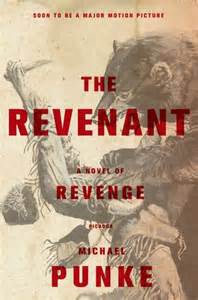
The Revenant

"Avenge not yourselves, but rather give place unto wrath:
for it is written, Vengeance is mine; I will repay, saith the Lord."
Rom. 12:19

I love a good revenge story. I think a lot of people do. I think it makes us feel better when the bad guys get their just rewards and when its at the hands of the good guys, all the better. It is what makes books like Moby Dick, and Terentino movies so popular. It makes us feel better to see that someone is seeing justice served in a world that seems to be so very unjust. So when I stumbled across The Revenant, by Michael Punke, I jumped at the chance to read it. No just a revenge story set in the west, with trappers and traders and bears, but a revenge story based on the life of a person who lived, and an extremely interesting person at that. 

The Revenant tells the story of mountain man Hugh Glass, who was mauled by a grizzly bear and then abandoned and robbed by his comrades. He then worked his way back to civilization, healed, and went back into the wilderness to find them and settle the score (historically, these things really happened). He had an extremely interesting life, starting out as a sailor, then an involuntary pirate, and then a fur trapper. It seems odd that this is the first tall tale story I've seen told of him, though there are several non-fiction books that tell the tail.

I really liked this book. The story is fascinating, and the author did a very good job describing what the Rocky mountains were like in the 1820's from the weather to the interactions with the several indigenous tribes (touching on the racism and vaguely on the beginnings of the wars that would expand to that part of the continent later in the century).  I really liked the writing. It was blunt and concise, but also filled with wonderful little bits of poetic writing when talking about the landscape and the wild life that lived there: the wolves and the buffalo. Even the way he talks about how the "colder weather settled into Glass's wounds the way a storm creeps its way up a mountain valley" waxes poetic. I feel like this style of writing reflects how Glass (or maybe even the author) felt about the world. Men are corrupt and blunt, yet nature is innocent, and beautiful in its untamed state. 

This book was wonderful. I highly recommend reading it, especially before the movie starring Leo DiCaprio comes out later this year. It looks particularly hair raising and awesome though it seems to focus more on the action, which is fairly sparse in the book. Read it before you see it!